
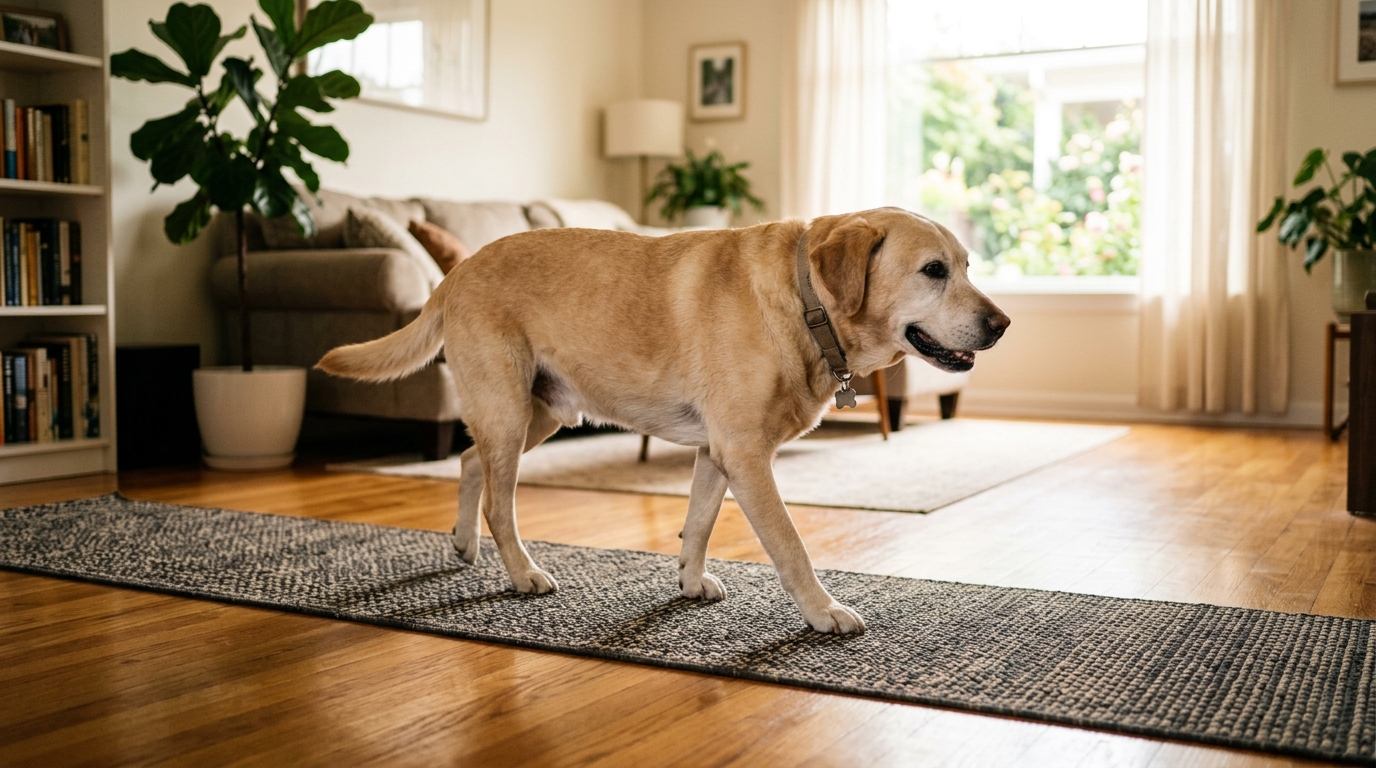
For a healthy young canine, polished hardwood floors, glazed ceramic tiles, and glossy luxury vinyl plank (LVP) represent minor aesthetic features of modern residential design. But for a senior dog navigating osteoarthritis, hip dysplasia, lumbosacral stenosis, or degenerative myelopathy, slick flooring is a terrifying sheet of glare ice. A single involuntary slip on a smooth kitchen floor can strain compensatory muscles, rupture an already compromised cruciate ligament, and trigger deep psychological “traction anxiety” that confines an aging dog to an isolated rug for days.
- The Micro-Slip Epidemic: Senior dogs suffering from joint capsule laxity experience continuous micro-slips with every stride on hard floors, inducing chronic bilateral spasm in the iliopsoas and pectineus muscles.
- The Traction Highway Mandate: Placing interconnected, rubber-backed non-slip runner rugs along major thoroughfares (bed to water bowl, living room to back door) instantly restores confident locomotion and eliminates 90% of household falls.
- Toe Grips vs. Boots: Elastomer nail grips provide natural mechanical purchase without impairing paw pad proprioception. Non-skid socks twist, turning slick fabric down and causing catastrophic slip events.
- Cross-Referenced Senior Care: Coordinate these adaptations with our veterinary protocols on senior dog mobility and home adaptations and our clinical evaluation of Librela vs. Adequan vs. PRP joint injections.
Why Are Hardwood and Tile Floors Dangerous for Senior Arthritic Dogs?
Dogs naturally grip surfaces by digging their non-retractable toenails into earth, grass, or carpet. On slick hardwood and tile, toenails slip frictionlessly, forcing the paw to splay outward. This outward splay places extreme eccentric shear stress across the hips, lower lumbar spine, and cranial cruciate ligaments.
In a youthful canine, rapid neuromuscular reflexes instantly fire stabilizing motor units to catch a slight slip. In a senior dog, age-related motor unit loss, reduced proprioceptive feedback, and sarcopenic muscle wasting delay reflex response times. When their rear legs splay outward on a slippery surface, the joint capsule of the hip absorbs the full kinetic shock.
The damage is not merely physical—it is deeply psychological. After experiencing two or three traumatic slips, dogs develop floor phobia. They stand paralyzed at the edge of carpeted living rooms, panting and trembling, refusing to walk across the 6-foot stretch of hardwood required to reach their food or water bowl. This immobilization accelerates muscular atrophy, locking the dog into a rapid downward physical spiral.
| Traction Aid | Mechanism of Action | Proprioceptive Impact | Durability & Maintenance | Veterinary Verdict |
|---|---|---|---|---|
| Rubber-Backed Runner Rugs | Continuous textured pathways over flooring | 100% Natural Paw-to-Surface Contact | High (Washable, lasts for years) | Gold Standard (Zero Risk) |
| Elastomer Toe Grips (Nails) | Rubber rings fitted onto weight-bearing nails | Excellent (Paws touch floor naturally) | Moderate (Requires replacement every 4–8 wks) | Highly Effective Secondary Aid |
| Non-Skid Grip Socks | Fabric booties with silicone tread on sole | Poor (Muffles tactile sensory nerves) | Twists easily; causes sudden slip falls | Not Recommended (Fall Hazard) |
| Paw Pad Wax / Grip Sprays | Beeswax coating applied to dry pad leather | Neutral | Very Low (Wears off in 1–2 hours) | Temporary / Insufficient for Arthritis |
Architecting the “Traction Highway”: Home Modification Layout
Map your home through your dog’s eyes: identify every origin and destination point (sleeping bed, water bowl, feeding station, back door). Lay washable, non-slip runner rugs with dense rubber backing along these paths, leaving no bare floor gap wider than 12 inches between rugs.
When selecting runner rugs for senior dogs, avoid lightweight woven rugs that bunch up or slide across the floor. Look for heavy commercial-grade runners featuring vulcanized non-slip TPR or natural rubber backing. These grip the subfloor securely, ensuring the rug does not shift when an arthritic 70 lb dog pushes off with their rear paws to stand.
Furthermore, never overlook paw hygiene. As dogs age, hair between the digital and metacarpal paw pads grows rapidly. When this hair extends beyond the pad leather, the dog effectively walks on slick silky socks. Trim interdigital hair flush with the paw pads every two weeks using a rounded-tip safety clipper, and apply a dab of organic shea butter to soften dry, hardened pad leather.
Ramp Incline Physics: Why 18 Degrees Is the Hard Physiological Ceiling
When transitioning senior dogs into vehicles or onto elevated beds, steps and stairs become agonizing biomechanical barriers. While ramps provide a gradual alternative, pet owners frequently purchase ramps that are far too short, creating dangerous ski-slope angles:
In canine rehabilitation therapy, an incline exceeding 18 to 20 degrees forces the dog to lean heavily forward on their front limbs during ascent, and places severe eccentric braking strain on the stifle joints and hip extensors during descent. For an SUV with a 30-inch cargo sill, a ramp must be at least 70 to 80 inches in length to maintain a safe, gentle gradient. Always choose ramps with high-traction sandpaper grip tape or dense ribbed rubber surfacing rather than slick plastic.
Modifying our homes for our senior dogs is an act of deep veterinary compassion and architectural necessity. We spend thousands of dollars on regenerative joint injections, specialized pharmaceuticals, and orthopedic surgeries, yet we allow our dogs to risk their lives on frictionless hardwood every morning. Installing a continuous network of high-traction runner rugs, trimming pad fur, and adhering to strict ramp incline limits costs a fraction of an orthopedic repair—and it returns to our aging companions the priceless dignity of fearless, independent mobility.
People Also Ask
How do Dr. Buzby’s Toe Grips work on dogs?
Dr. Buzby’s Toe Grips are small, flexible natural rubber cylinders that slide onto a dog’s weight-bearing toenails. Because a dog’s nails naturally touch the floor with each stride, the rubber rings grip the slick surface like tire treads, providing mechanical traction without covering the sensitive paw pad.
What is the best orthopedic bed for a senior arthritic dog?
The best orthopedic bed features a solid dual-density memory foam core (at least 4 to 6 inches thick with medical-grade support foam underneath) that does not bottom out when heavy pressure is applied. Avoid shredded foam or polyfill pillows, which provide zero joint support.
Why does my senior dog’s back legs keep sliding out?
Weakness and outward splaying in the rear legs is typically caused by advanced hip dysplasia, bilateral knee osteoarthritis, or neurological degeneration (such as degenerative myelopathy or lumbosacral disease). Consult your veterinarian immediately for a complete neurological and orthopedic evaluation.
Are stairs bad for dogs with arthritis?
Yes. Navigating stairs places repetitive concussive impact on the elbows and shoulders during descent, and forces extreme torque on arthritic hips during ascent. Staircases should be blocked with sturdy baby gates, with ramps installed where elevation changes are unavoidable.
Related Investigations: Explore Canine Hydrotherapy & Underwater Treadmills for CCL Rehab and our forensic checklist for Senior Dog Annual Exams & Essential Lab Work.