
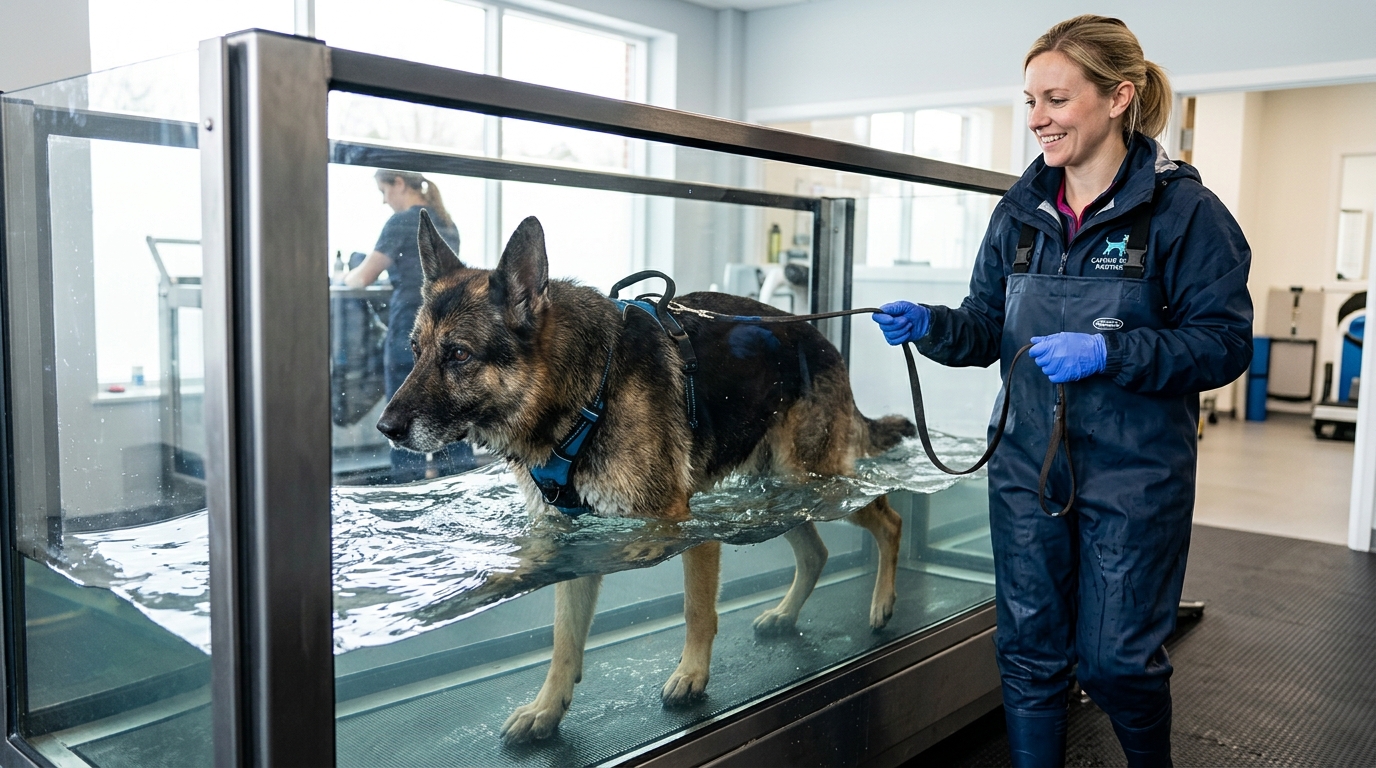
Maintaining joint comfort, lean skeletal muscle mass, and postural stability represents the cornerstone of extended healthspan in senior and arthritic dogs. However, as cartilage matrix degradation, osteophyte formation, and chronic synovitis advance, terrestrial walking often becomes self-limiting. The impact shock of hard ground surfaces creates pain cycles that discourage movement, leading directly to rapid muscle sarcopenia, compensatory spinal strain, and accelerated physical frailty.
In 2026, certified canine physical rehabilitation practitioners (CCRP) have established underwater treadmill (UWTM) hydrotherapy as the primary clinical standard for low-impact joint conditioning. By leveraging the physical properties of water—buoyancy, hydrostatic pressure, viscosity, and surface tension—canine hydrotherapy allows senior, post-operative, and neurologically compromised dogs to rebuild muscular strength, restore joint range of motion (ROM), and achieve cardiovascular exercise without damaging high-load joint concussive force.
- Buoyancy Physics & Load Offloading: Filling an underwater treadmill to the level of the greater trochanter (hip joint) offloads up to 62% of a dog’s static body weight, dramatically reducing peak compressive forces across the coxofemoral and stifle joints while maintaining ground contact mechanics.
- Post-Op CCL / TPLO Rehabilitation: Initiating early hydrotherapy between 10 to 14 days post-operatively (following suture removal) prevents periarticular fibrosis, enhances quadriceps and hamstring muscle hypertrophy, and accelerates full functional weight-bearing recovery.
- Hydrostatic Pressure & Edema Reduction: The inward pressure exerted by water promotes peripheral venous and lymphatic drainage, helping reduce chronic joint effusion, soft tissue swelling, and distal extremity fluid retention.
- Water Temperature Thermoregulation: Clinical canine hydrotherapy tanks must maintain water temperatures between 29°C and 32°C (84°F to 90°F) to maximize muscle vasodilation, ease joint stiffness, and prevent hypothermic muscle cramping.
The Biomechanics of Hydrotherapy: Buoyancy, Viscosity & Hydrostatic Pressure
To design an effective rehabilitation protocol, veterinary physical therapists manipulate four core hydrodynamic principles that distinguish water immersion from terrestrial exercise:
- Relative Buoyancy (Archimedes’ Principle): Buoyancy acts in direct opposition to gravity. By adjusting water depth relative to specific canine anatomical landmarks, clinicians can systematically modulate joint load:
- Water at Hock / Tarsus Level: Offloads approximately 9% to 15% of body weight (used for high-resistance conditioning and proprioceptive input).
- Water at Stifle (Knee) Level: Offloads approximately 15% to 25% of body weight, enhancing flexion and extension ROM.
- Water at Greater Trochanter (Hip) Level: Offloads approximately 55% to 62% of body weight, allowing dogs with severe hip dysplasia, advanced osteoarthritis, or post-operative fractures to ambulate pain-free.
- Viscosity & Hydrodynamic Drag: Water is approximately 700 times denser than air. Moving through water provides uniform, concentric resistance across all planes of motion, strengthening opposing muscle groups (agonists and antagonists) simultaneously without eccentric shear forces.
- Hydrostatic Pressure: Pascal’s law dictates that fluid exerts equal pressure on all surfaces of an immersed body at a given depth. This external pressure compresses superficial veins and lymphatic channels, actively flushing metabolic waste and reducing chronic inflammatory joint effusions.
Clinical Protocol Matrix: Tailoring Depth, Speed & Duration
Canine hydrotherapy is not generic swimming; swimming often causes uncontrolled spinal extension, excessive front-leg paddling, and hyperextension of rear limbs that can exacerbate cranial cruciate injuries or spinal spondylosis. The underwater treadmill allows precise, biomechanically controlled rehabilitation:
| Clinical Condition | Target Water Level | Belt Speed Range | Session Progression | Primary Clinical Goal |
|---|---|---|---|---|
| Post-Op TPLO / CCL Rupture | Stifle to Hip (60% offload early) | 0.8 – 1.4 mph (Slow controlled pace) | 5 min early → 15 min by Week 8 | Restore symmetrical weight-bearing & quadriceps muscle mass |
| Senior Hip Dysplasia & OA | Greater Trochanter (Hip depth) | 1.0 – 1.6 mph (Comfortable cadence) | 8 min → 20 min twice weekly | Reduce coxofemoral loading & preserve pelvic limb musculature |
| Spinal Spondylosis / IVDD Phase 2 | Mid-chest / Shoulder level | 0.6 – 1.0 mph (Proprioceptive focus) | 3–5 min intervals with rest breaks | Spinal axial decompression & neurological gait re-education |
| Canine Obesity Weight Management | Stifle to Mid-femur (Moderate drag) | 1.5 – 2.2 mph (Aerobic pace) | 15 min → 25 min 3x weekly | Caloric expenditure without orthopedic cartilage wear |
Multimodal Integration: Pairing Hydrotherapy with Advanced Therapies
While hydrotherapy provides mechanical exercise and joint decompression, optimal functional recovery in senior canines requires an integrated, multimodal pain management protocol. Combining hydrotherapy with biological and pharmaceutical joint interventions creates powerful clinical synergies:
- Pairing with Adequan (PSGAGs): Polysulfated glycosaminoglycans inhibit degradative matrix metalloproteinases in articular cartilage while stimulating hyaluronic acid production. Exercising in warm water increases synovial fluid circulation, delivering therapeutic molecules deeper into cartilage matrices.
- Synergy with Monoclonal Antibodies (Librela / Bedinvetmab): By neutralizing Nerve Growth Factor (anti-NGF), bedinvetmab lowers central sensitization and joint pain signals. Hydrotherapy leverages this pain-free window to actively rebuild the muscular moats needed to stabilize degenerated joints over the long term.
- Whole-Food Omega-3 Synergy: High-dose EPA/DHA fatty acids reduce circulating eicosanoid and leukotriene inflammatory cascades, shortening post-hydrotherapy muscular recovery periods in geriatric patients.
The greatest threat to a senior dog’s longevity is rarely old age itself—it is the insidious loss of functional mobility. Once a senior dog can no longer stand, walk comfortably, or eliminate independently, quality of life deteriorates precipitously. Underwater treadmill hydrotherapy is not a luxury spa treatment; it is a vital, evidence-based orthopedic prescription. By unburdening diseased joints through precise buoyancy while providing concentric muscular conditioning in warm water, hydrotherapy preserves the physiological mobility moat that keeps senior canines vibrant and active well into their teens.
People Also Ask
How does an underwater treadmill help an arthritic dog?
An underwater treadmill uses water buoyancy to offload up to 60% of a dog’s body weight, dramatically reducing painful joint compression. The warmth of the water (around 30°C/86°F) eases joint stiffness, while water resistance gently rebuilds supporting leg and core muscle mass without concussive impact.
Is hydrotherapy safe for dogs after CCL cruciate (TPLO) surgery?
Yes. In fact, certified veterinary rehabilitation practitioners consider underwater treadmill therapy one of the gold standards for TPLO recovery. Once surgical incisions are fully healed (usually 10–14 days post-op), controlled water walking accelerates bone healing, builds muscle mass, and restores normal weight-bearing.
What is the difference between dog swimming and an underwater treadmill?
Open swimming involves non-weight-bearing paddling that can cause excessive front-leg strain, spinal extension, and vigorous kicking that may harm injured knees or backs. The underwater treadmill maintains normal ground contact mechanics, allowing the therapist to control speed, water height, and posture safely.
How often should an older dog do hydrotherapy?
For senior dogs with chronic osteoarthritis, hip dysplasia, or spondylosis, most veterinary physical therapists recommend starting with two sessions per week for 4 to 6 weeks, transitioning to a maintenance cadence of once weekly to preserve lean muscle and joint comfort.