
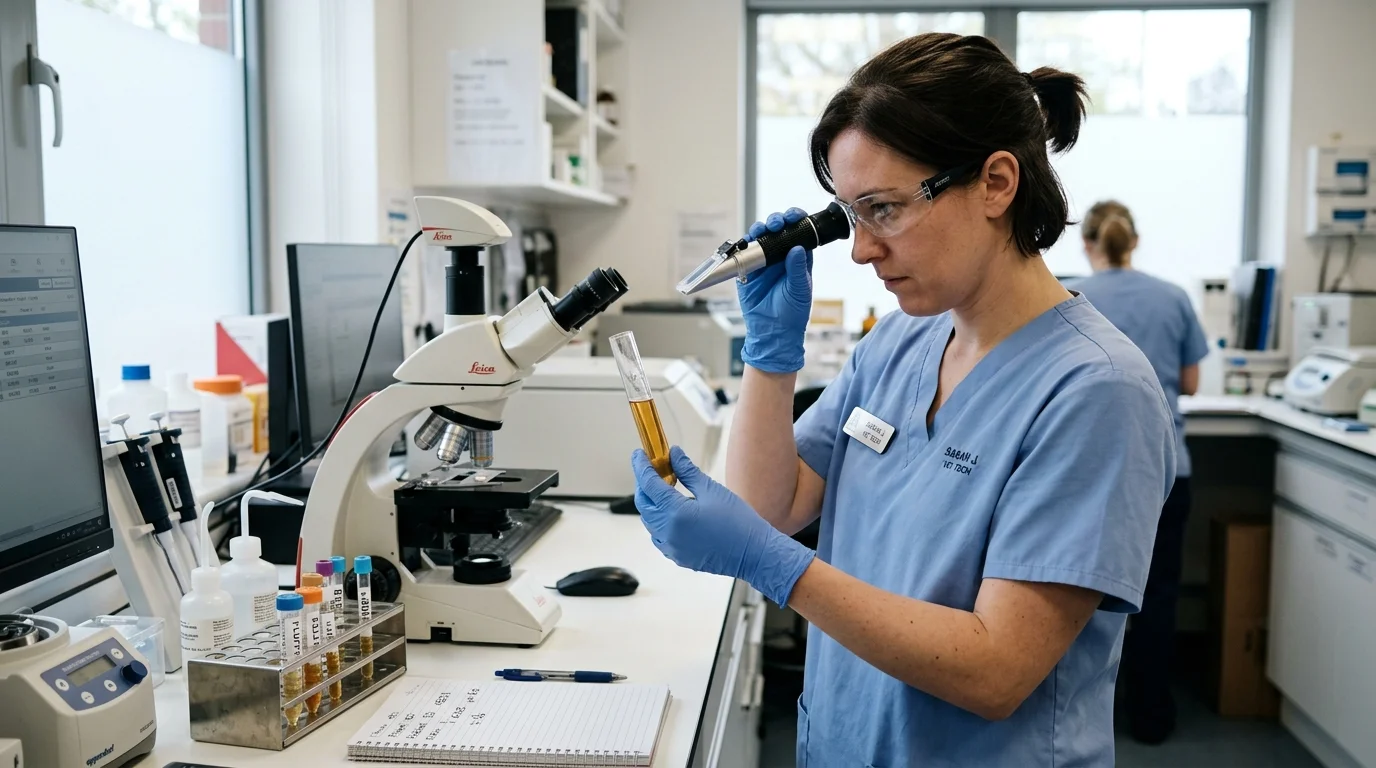
Why Is Urinalysis Just as Important as Bloodwork for Senior Dogs?
The canine kidney consists of hundreds of thousands of delicate functional filtering units called nephrons. As dogs enter their senior years (ages 7 and older), glomerulosclerosis, chronic tubulointerstitial nephritis, and microvascular hypertension steadily erode nephron numbers. The earliest functional defect is not the inability to excrete waste products into the blood, but rather the loss of tubular concentrating ability.
When evaluated via an optical veterinary refractometer, Urine Specific Gravity (USG) reveals how effectively the renal medullary countercurrent mechanism concentrates filtrate. A normal, well-hydrated canine produces urine with a USG greater than 1.030. When USG drops consistently into the isosthenuric range (1.008 to 1.012)—meaning the urine is neither concentrated nor diluted compared to blood plasma—it signals that two-thirds of functional nephrons are compromised, perfectly harmonizing with senior dog bloodwork chemistry.
What Does the Urine Protein-to-Creatinine (UPC) Ratio Measure?
Standard dipstick tests are notoriously unreliable for protein detection because they are heavily influenced by urine concentration and pH. A “1+” protein on a dipstick in concentrated urine (USG 1.045) may be completely physiological, whereas a “1+” protein in dilute urine (USG 1.012) represents catastrophic protein loss. The UPC ratio normalizes protein excretion against creatinine clearance, providing an unyielding mathematical baseline of glomerular health.
| Urinalysis Diagnostic Marker | Reference Range | Pathological Significance If Abnormal | Recommended Action |
|---|---|---|---|
| Urine Specific Gravity (USG) | > 1.030 | Isosthenuria (1.008–1.012): >66% nephron loss | Serum SDMA blood test, blood pressure check |
| Urine Protein:Creatinine (UPC) | < 0.2 | > 0.5: Persistent glomerular hypertension/damage | Initiate telmisartan/enalapril, renal diet |
| Microscopic Sediment (WBC/RBC) | 0 – 3 / HPF | Pyuria or hematuria: UTI, urolithiasis, neoplasia | Urine culture & sensitivity (C&S), bladder ultrasound |
| Urine Glucose | Negative | Glucosuria: Diabetes mellitus or Fanconi syndrome | Fasting blood glucose, fructosamine panel |
Should Urine Be Collected by Cystocentesis or Free-Catch?
When collecting a free-catch sample at home, always catch mid-stream urine in a sterile container after the initial flush has passed. Keep the sample refrigerated and submit it to your veterinary lab within 2 hours; prolonged room-temperature storage causes in-vitro bacterial overgrowth, cellular breakdown, and artificial precipitation of struvite crystals.
Before scheduling pre-anesthetic dental procedures, review our master guide on interpreting Senior Dog Dental Disease: Anesthesia Risks vs. COHAT.