
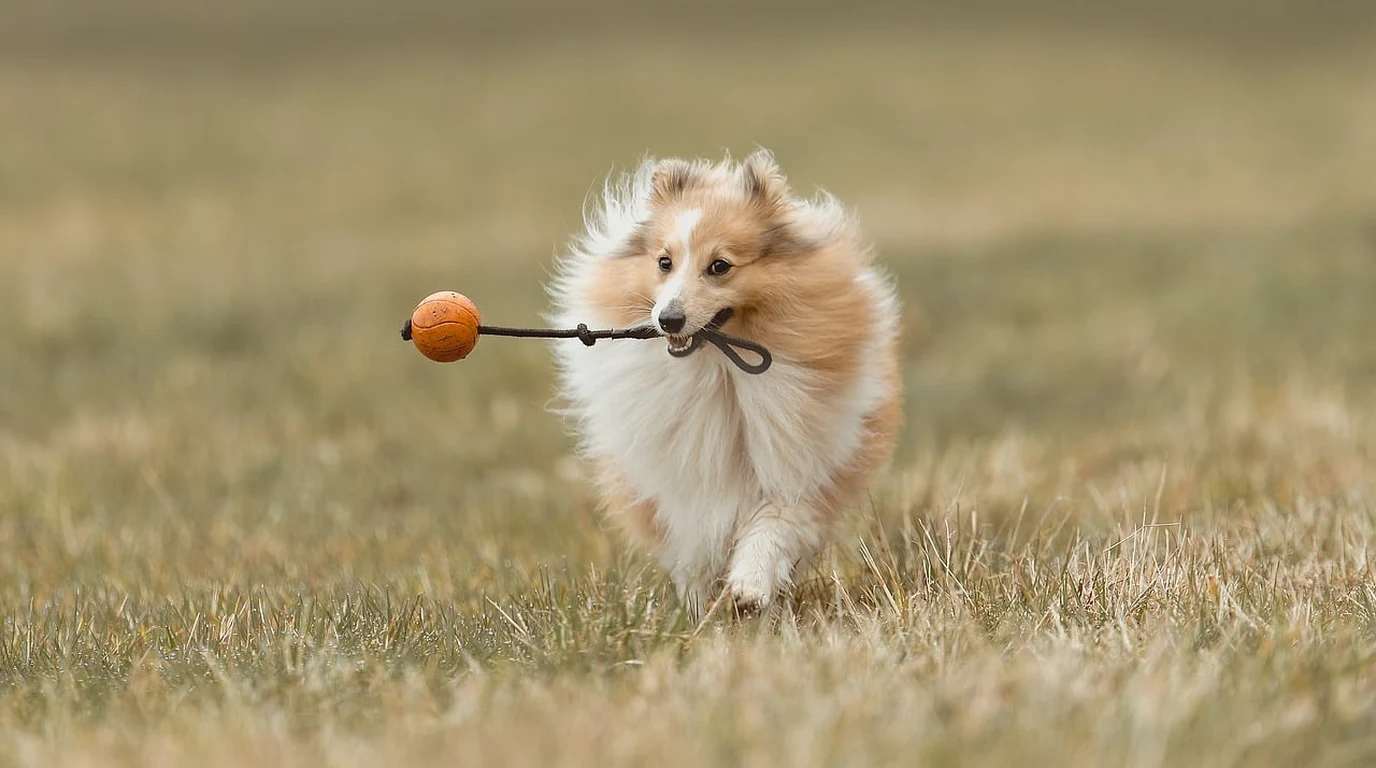
The Biology of the Chase: Why Flirt Poles Exhaust Your Dog So Fast
A flirt pole mimics the erratic movement of small prey, triggering your dog’s biological chase sequence. This intense combination of rapid acceleration, sudden deceleration, and high-focus mental stimulation drains their energy far faster than traditional running. However, improper use on hard surfaces or encouraging mid-air twists can cause catastrophic joint damage.
When you take your dog for a standard two-mile walk, they are primarily engaging in steady-state aerobic exercise. While beneficial for cardiovascular health, steady-state movement rarely exhausts a high-drive dog. The reason is evolutionary: canines are cursorial predators designed for prolonged trotting over vast distances. To truly tire a working breed, a terrier, or a high-energy rescue, you must activate the anaerobic system and the neurological prey drive simultaneously. This is precisely what a flirt pole achieves.
A flirt pole is essentially a giant cat toy for dogs—a long stick with a bungee cord attached, ending in a high-value lure (like a fleece rag or a squeaky toy). When you drag the lure across the ground, it mimics the sudden, erratic movements of a fleeing rabbit or squirrel. This visual stimulus bypasses the dog’s conscious decision-making and directly triggers the predatory motor sequence: orient, eye, stalk, chase, grab, bite, dissect, consume. The flirt pole primarily targets the chase and grab phases.
The resulting physical exertion is immense. During a flirt pole session, a dog’s body relies on fast-twitch muscle fibers for explosive acceleration, sharp lateral cuts, and rapid braking. This anaerobic exertion depletes glycogen stores rapidly, leading to quick physical fatigue. More importantly, the mental focus required to track a fast-moving, unpredictable target demands immense cognitive processing. Ten to fifteen minutes of intense flirt pole play can leave a dog more mentally and physically exhausted than an hour of jogging on a leash.
However, tapping into this primal drive requires a profound respect for the biological load placed on the dog’s anatomy. When a dog is locked onto a moving target, their adrenaline and endorphin levels spike, effectively masking pain. They will not stop if they tweak a muscle or strain a ligament; their brain is entirely consumed by the objective of capturing the lure. It is the handler’s absolute responsibility to dictate the pace, enforce the rules, and manage the environment to prevent catastrophic injury.
The Grave Danger of Joint Injuries: Protecting the Cranial Cruciate Ligament (CCL)
The most severe risk associated with flirt pole use—and the reason many veterinary orthopedic surgeons view them with caution—is the potential for traumatic joint injury, specifically tears to the Cranial Cruciate Ligament (CCL). The canine CCL is the equivalent of the human ACL (anterior cruciate ligament), stabilizing the knee (stifle) joint by preventing the tibia from sliding forward relative to the femur.
During flirt pole play, handlers often make the mistake of swinging the lure high into the air, prompting the dog to leap. When a dog jumps to catch an airborne lure, their trajectory is dictated by the movement of the object. If the handler shifts the lure while the dog is mid-air, the dog will instinctively twist their spine and pelvis to adjust. When they land, all their downward kinetic energy and rotational momentum are driven into a single hind leg planted at an awkward angle.
This rotational force (torque) applied to a planted, hyperextended stifle joint is the exact mechanical trigger for a CCL rupture. A complete tear of the CCL requires expensive orthopedic surgery (typically a TPLO—Tibial Plateau Leveling Osteotomy) with a prolonged, grueling recovery period of six to twelve weeks. Even a partial tear leads to chronic instability, inflammation, and inevitable osteoarthritis.
To eliminate this risk, the golden rule of flirt pole use is non-negotiable: Keep the lure on the ground.
The objective is to simulate a ground-dwelling prey animal scurrying through the brush, not a bird taking flight. By dragging the lure along the ground, the dog keeps all four paws on the earth, evenly distributing their weight and allowing their muscles to absorb the forces of acceleration and deceleration. If you lift the pole to change direction, ensure the dog is not in the immediate striking zone, and lower the lure before they initiate a grab.
| Flirt Pole Movement | Biomechanical Impact | Injury Risk Profile |
|---|---|---|
| Lure dragged horizontally on the ground | Weight distributed across four limbs; muscles absorb lateral force. | Low (Safe when combined with proper footing) |
| Lure pulled in wide, smooth circles | Promotes fluid spinal extension and controlled banking. | Low |
| Sharp, unpredictable zig-zags (Ground) | Requires rapid braking and re-acceleration; places shear force on joints. | Moderate (Requires warm-up and conditioning) |
| Lure jerked vertically into the air | Forces mid-air spinal twisting and single-leg rotational landings. | Extreme (High probability of CCL rupture) |
Surface Areas and Session Limits: The Rules of Engagement
The environment in which you deploy the flirt pole is just as critical as the mechanics of the game itself. The friction coefficient and impact absorption properties of the surface directly dictate the longevity of your dog’s joints and paw pads.
Never use a flirt pole on concrete, asphalt, or tile. These surfaces are entirely unforgiving. Concrete offers zero shock absorption, meaning the full kinetic force of every leap, brake, and pivot is transferred directly through the dog’s metacarpals and up into the elbows and shoulders. Furthermore, the abrasive nature of concrete will act like a cheese grater on the dog’s paw pads when they attempt to brake from a sprint, leading to severe avulsions (torn pads) that take weeks to heal. Indoor use on slippery hardwood or tile is equally disastrous, as the dog will lack traction, leading to splayed legs, groin pulls (iliopsoas strains), and traumatic impacts against furniture.
The only acceptable surfaces for high-intensity flirt pole work are natural, shock-absorbing terrains with high traction. A flat, well-maintained lawn with short grass is the gold standard. Dirt fields, soft sand, and specialized athletic turf are also excellent alternatives. Ensure the area is clear of hidden divots, sprinkler heads, or debris that could twist an ankle during a high-speed pursuit.
Equally important is managing session duration. Because the flirt pole taxes the anaerobic system so heavily, sessions must be kept remarkably short. A fully conditioned adult dog should only engage in active chasing for 10 to 15 minutes per session. Puppies under 18 months (whose growth plates are not yet fused) should avoid high-speed lateral flirt pole work entirely, though they can engage in gentle, slow dragging to build basic impulse control.
Always implement a structured protocol: warm the dog up with a five-minute walking trot before beginning, and enforce frequent two-minute cooling breaks during the session to allow their heart rate to settle.
Impulse Control: Building the Mental Brakes (Wait, Drop It, Get It)
A flirt pole is not merely a tool for physical exhaustion; it is one of the most powerful apparatuses available for installing iron-clad impulse control. If you simply drag the lure and let the dog chase it chaotically until they collapse, you are failing to harness the cognitive benefits of the exercise. You are building a stronger, faster dog, but not a more disciplined one.
The true value of the flirt pole lies in teaching the dog to engage their “mental brakes” while in a state of high arousal. By requiring obedience commands before, during, and after the chase, you teach the dog that access to their deepest biological desires requires self-regulation.
Every session must be governed by three unyielding commands:
- Wait (or Stay): Before the game begins, the dog must hold a sit or a down stay. You drag the lure tantalizingly across the ground in front of them. The dog must learn to watch the “prey” move without breaking position. If they break the stay, the game instantly stops, and the lure is hidden behind your back. The dog only gets to chase when you issue the release word (e.g., “Get it!” or “Strike!”). This installs a crucial pause mechanism in the dog’s predatory sequence, teaching them to look to you for permission before acting on instinct.
- Drop It (or Out): When the dog successfully catches the lure, they must be taught to release it on command. Do not engage in a tug-of-war while the dog is holding the lure on the flirt pole (the bungee cord can snap back and injure you both). Instead, make the lure go “dead” by freezing your movement. A motionless prey item is boring. Issue the “Drop it” command calmly. If the dog struggles, trade them a high-value treat from your pocket for the lure. Once they release it, immediately mark the behavior and reward them by initiating another chase sequence. The reward for dropping the prey is getting to chase the prey again.
- Leave It: If the dog misses the lure and the game halts, they must be able to back away from the stationary object and reset into a sit or down. This reinforces that the game is controlled entirely by the handler, not by the object itself.
By enforcing these rules, the flirt pole transforms from a mindless physical outlet into a sophisticated neurological conditioning tool. A dog that can down-stay while a furry lure whips past their nose will have significantly fewer issues ignoring a squirrel across the street or a cyclist passing by on a trail.
Choosing the Right Equipment
The durability and design of the flirt pole are paramount for safety. A flimsy plastic pole or a thin string will inevitably fail, potentially causing injury from snapping back into the handler’s face or breaking mid-stride. Here are the core specifications to look for:
- The Pole: Should be made of high-tensile material, such as reinforced PVC, lightweight aluminum, or fiberglass. It should measure between 36 and 48 inches to give the handler adequate leverage and reach without straining their back.
- The Line: Never use static rope or thin string. The line must be a durable bungee cord or have a shock-absorbing segment. When a 60-pound dog hits the lure at full sprint, a static line will jerk their neck violently and simultaneously wrench the handler’s shoulder. A bungee line absorbs this kinetic shock, protecting both parties.
- The Lure: Avoid hard plastic toys or items with squeakers that can be ingested if torn. The best lures are soft, durable materials like braided fleece or real animal hide (for high-drive working dogs). The lure must be easily replaceable, as it will take immense abuse.
The flirt pole is an unmatched tool for canine conditioning and obedience, capable of draining a high-drive dog’s energy in a fraction of the time required by traditional walking. However, it must be treated with the respect of a heavy barbell. The biological load on the dog’s anaerobic system and joint structure is immense. By keeping the lure grounded, operating strictly on shock-absorbing surfaces like grass, and enforcing rigorous impulse control commands (Wait, Drop It), handlers can safely harness this primal drive. Misuse—particularly inducing mid-air rotational jumps or playing on concrete—will invariably lead to catastrophic joint failure and veterinary surgical intervention.
Frequently Asked Questions
Is a flirt pole bad for a dog’s joints?
A flirt pole is not inherently bad for joints, but improper use is highly destructive. The primary risk is a Cranial Cruciate Ligament (CCL) tear, which occurs when a dog jumps after a high lure and twists mid-air, landing on a single, planted hind leg. To protect the joints, the lure must always be kept on the ground, and play must only occur on soft, high-traction surfaces like grass.
At what age can a puppy use a flirt pole?
Puppies under 12 to 18 months should not engage in high-speed, sharp-turning flirt pole play. Their growth plates are not yet fully closed, making their bones and joints highly susceptible to permanent damage from shear forces. Puppies can be introduced to the concept with slow dragging to teach impulse control (Sit, Wait, Drop It), but explosive sprinting must wait until skeletal maturity is confirmed by a veterinarian.
How long should a flirt pole session last?
Sessions should be remarkably brief—typically 10 to 15 minutes for a healthy, conditioned adult dog. Because flirt pole play is heavily anaerobic and engages the fast-twitch muscle fibers, dogs exhaust rapidly. Prolonging the session past the point of fatigue leads to sloppy biomechanics, significantly increasing the risk of muscle strains and joint injuries.
Why does my dog refuse to drop the flirt pole lure?
High prey drive dogs lock onto the lure, and the adrenaline surge makes them reluctant to release their “kill.” Never engage in a tug-of-war. Instead, freeze your movement to make the lure “dead.” Command “Drop It,” and immediately offer a high-value treat right in front of their nose. When they open their mouth to take the treat, praise them and resume the game. Over time, they learn that dropping the lure is the key to restarting the chase.
High-intensity physical play must be balanced with calm mental enrichment. Learn how olfactory foraging relieves stress in our analysis on Snuffle Mats for Dogs: Stress Relief & Brain Games.