
For decades, traditional dog training dogma has conditioned pet owners to believe that a “good dog walk” consists of a rigid, military-style heel: the dog walking in lockstep at the handler’s left knee on a short 4-to-6-foot leash, eyes glued forward, forbidden from stopping, sniffing, or deviating from the human’s brisk sidewalk pace. Conscientious owners walk their dogs for miles every evening under this structured regime, only to return home to a dog that remains restless, hyper-aroused, pacing, or barking at minor exterior sounds. Despite physical exertion, the dog’s nervous system remains trapped in a state of chronic sympathetic stress.
In modern veterinary behavioral science and applied ethology, this phenomenon is well understood: physical fatigue is not equivalent to neurological fulfillment. Dogs do not experience their environment through vision or auditory cues in the way humans do; they navigate the world primarily through an astonishing olfactory sensory apparatus. Forcing a dog to march past hundreds of fascinating olfactory stimuli on a tight leash frustrates natural foraging drives and spikes physiological stress hormones. The revolutionary alternative is the decompression walk (colloquially known as a “sniffari”)—an open-ended, low-stress sensory exploration on a long line that activates the parasympathetic nervous system, slashes cortisol, and satisfies fundamental canine psychological needs.
What Is a Decompression Walk for Dogs?
A decompression walk is an off-leash or long-line (15 to 30 feet) walk in a quiet, low-distraction natural environment where the dog sets the pace, chooses the route, and engages in uninterrupted olfactory sniffing. This sensory freedom activates the parasympathetic nervous system, significantly reducing salivary cortisol and anxiety.
The concept of canine decompression walking was pioneered by leading veterinary behaviorists (notably Sarah Stremming) to rehabilitate dogs suffering from chronic environmental stress, leash reactivity, and generalized anxiety. Unlike a traditional structured neighborhood walk—which is often fraught with triggers like passing delivery trucks, barking fence dogs, and tight leash tension—a decompression walk takes place in quiet, open natural spaces: open meadows, wooded trails, quiet school sports fields on weekends, or industrial business parks after hours.
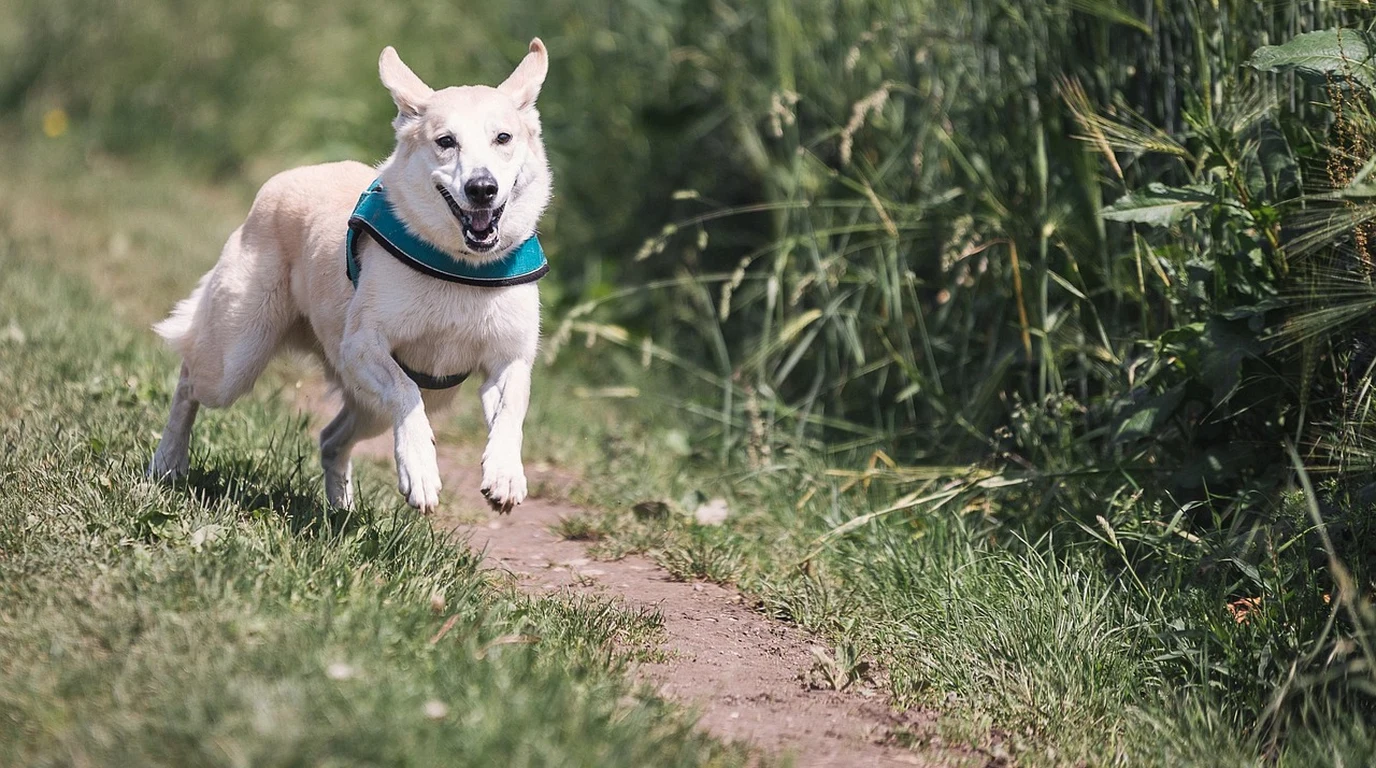
During a decompression walk, the human relinquishes micro-management. Fitted with a secure, ergonomic Y-front harness and attached to a lightweight 15- to 30-foot biothane long line, the dog is given the freedom to wander, pause, backtrack, sniff tree roots, explore tall grass, and dig in the dirt. The goal is zero obedience drilling, zero leash pulling, and 100 percent natural species-typical canine behavior.
The Neuroscience of Olfaction: Cortisol Reduction & Dopamine Release
To appreciate why 30 minutes of sniffing exhausts a dog far more deeply than an hour of brisk sidewalk trotting, we must examine the canine olfactory neuroanatomy. A dog’s nasal architecture is an evolutionary masterpiece, housing between 200 million and 300 million olfactory receptor cells (compared to a paltry 5 million in humans). Furthermore, the percentage of the canine brain devoted to analyzing scent signatures is 40 times larger than the corresponding region in the human brain.
When a dog engages in deep, rhythmic olfactory investigation, profound biochemical shifts take place in their nervous system:
- Parasympathetic Vagal Activation: Prolonged sniffing naturally lowers canine respiratory and heart rates. The physiological act of engaging the olfactory bulb stimulates the vagus nerve, down-regulating the sympathetic “fight-or-flight” response and shifting the dog into the parasympathetic “rest-and-digest” state.
- Cortisol Suppression: Clinical behavioral studies measuring salivary cortisol levels in domestic canines have demonstrated that dogs provided regular olfactory foraging opportunities exhibit significantly lower circulating baseline cortisol compared to dogs restricted to structured short-leash heeling.
- Dopamine & Cognitive Fulfillment: Scent processing is an active problem-solving puzzle. Dogs use their dual-chambered nostrils and the vomeronasal organ (Jacobson’s organ) to decode complex temporal data: who walked here, how long ago, their sex, reproductive status, stress level, and what they ate. Solving these sensory puzzles triggers endogenous dopamine release, creating profound mental satisfaction and emotional stability.
Structured Heel Walk vs Decompression Walk: Comparative Analysis
| Operational Parameter | Traditional Structured Heel Walk | Long-Line Decompression Sniffari | Behavioral & Biological Outcome |
|---|---|---|---|
| Equipment Used | 4-to-6-foot static leash, flat collar or slip lead | 15-to-30-foot biothane long line, Y-shaped harness | Eliminates cervical spine pressure; restores natural gait mechanics |
| Handler Pace & Control | Human dictates continuous speed; dog must keep up | Dog dictates pacing, pauses, and path direction | Provides dog with sensory agency and environmental autonomy |
| Sniffing Opportunities | Severely restricted or corrected | 100% unrestricted olfactory investigation encouraged | Unlocks 40x brain engagement, slashing evening pacing and hyperactivity |
| Nervous System State | Elevated sympathetic vigilance (fight-or-flight) | Deep parasympathetic relaxation (rest-and-digest) | Reduces leash reactivity, barrier frustration, and indoor anxiety |
Julian Hayes’s Step-by-Step Decompression Walk Protocol
Never use retractable flexi-leashes for decompression walks. Retractable leashes maintain continuous tension on the dog’s neck or back, teaching them that pulling is required to move forward, and their thin cords pose severe laceration risks. A waterproof 15- to 30-foot biothane long line drags effortlessly through mud and brush without snagging, offering complete safety.
To successfully integrate decompression walks into your dog’s weekly healthspan routine, execute this four-step protocol:
- Select a Low-Distraction Environment: Scout a location where you are unlikely to encounter off-leash strange dogs, high bicycle traffic, or crowded pedestrian sidewalks. Unmowed country fields, nature conservation areas with low foot traffic, cemetery perimeters, or quiet business parks on Sunday mornings are prime locations.
- Fit a Non-Restrictive Y-Harness: Attach the long line exclusively to the back clip of a non-restrictive, Y-shaped harness that leaves the dog’s shoulder blades and trachea completely free of pressure. Never attach a long line to a collar or neck slip lead; if the dog sprints after a bird, the sudden stop on a 20-foot line could cause severe cervical neck trauma.
- Master Long-Line Handling: Hold the end handle securely, and gather or release the excess slack like a horse lead rope as your dog moves closer or further away. Allow the middle of the line to trail gently along the ground. When your dog stops to sniff a tree trunk for three minutes, stop and wait patiently. Do not pull or rush them.
- Schedule 2 to 3 Sniffaris Weekly: You do not need to abandon neighborhood walks entirely if your dog enjoys them, but dedicate 2 to 3 sessions per week specifically to 30-to-45-minute decompression walks. You will notice immediate improvements in indoor calmness, reduced reactivity on daily walks, and deeper restorative sleep.
For more enrichment and mental health strategies to optimize canine brain healthspan, read our investigative guide on diy scent games at home for olfactory enrichment and explore our clinical review of snuffle mats and cognitive enrichment toys for dogs.
People Also Ask
How long should a decompression walk be for a dog?
A typical decompression walk should last between 30 and 45 minutes. Because sniffing activates intensive cognitive processing, 30 minutes of unrestricted olfactory exploration provides profound mental enrichment and fatigue without overtaxing physical joints.
Can reactive dogs do decompression walks?
Yes! Decompression walks are especially vital for leash-reactive and anxious dogs. By removing the pressure of close encounters with strange dogs and triggers in open, quiet spaces, reactive dogs can finally decompress, lowering their chronic cortisol levels.
What is the best leash for a decompression walk?
The gold standard is a 15- to 30-foot biothane long line. Biothane is waterproof, odor-proof, does not tangle easily in brush, and allows handlers to maintain a secure grip even in wet weather. Avoid thin nylon webbing or retractable flexi-leashes.
Balanced nutrition directly reinforces canine mental decompression and behavioral health. Learn how outdoor enrichment lowers stress in our analysis of Protein Rotation Diet for Dogs: Gut Flora & Allergy Care.