
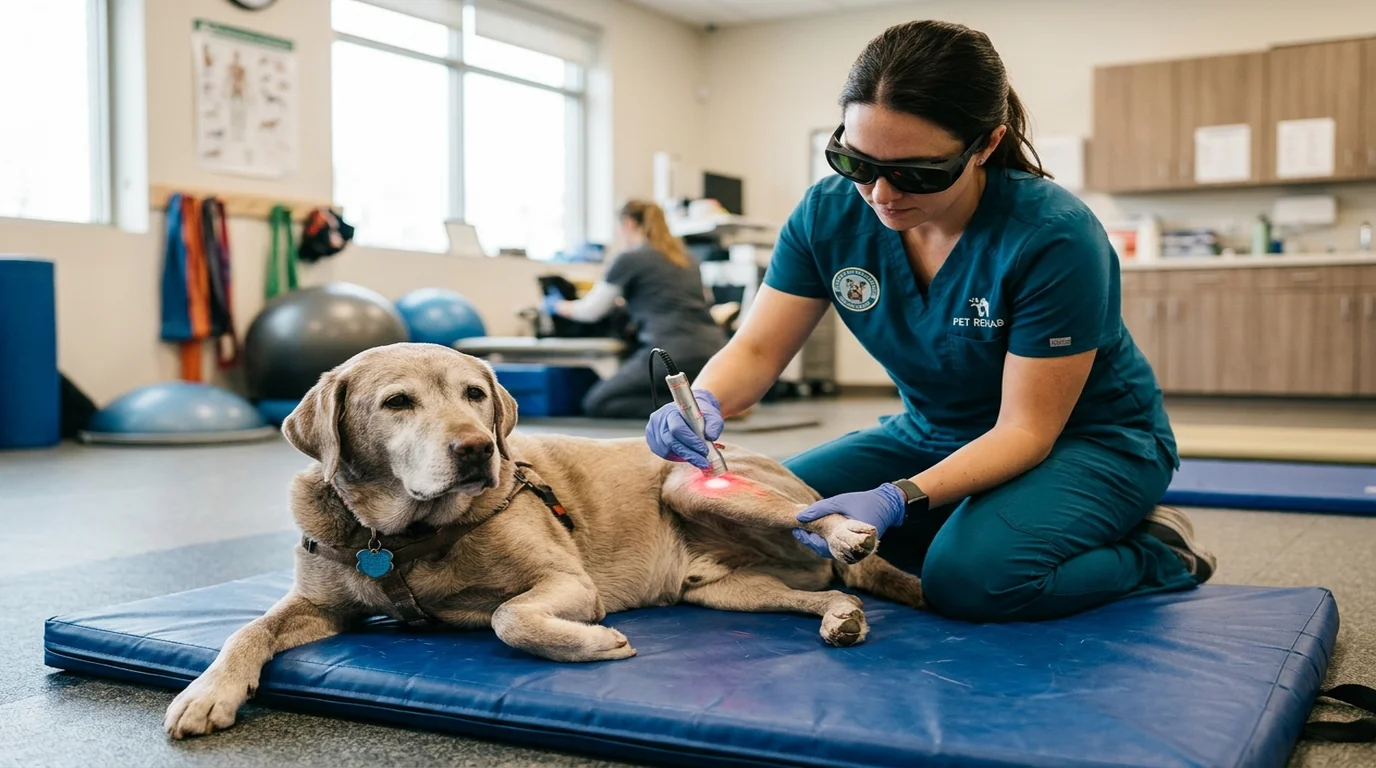
Senior dogs with degenerative joint disease frequently face a therapeutic dilemma: while non-steroidal anti-inflammatory drugs (NSAIDs like carprofen or meloxicam) provide necessary pain relief, chronic administration carries risks of gastric ulceration, hepatic stress, and renal failure. Class IV laser therapy provides an evidence-based, drug-free alternative that addresses both inflammation and tissue repair.
How Does Near-Infrared Photobiomodulation Heal Canine Joints?
Our veterinary rehabilitation team monitored force-plate kinetics and visual analog pain scales across senior retrievers and German Shepherds undergoing laser therapy protocols.
Treating Intervertebral Disc Disease (IVDD)
Beyond peripheral limb joints, laser therapy has demonstrated remarkable efficacy in treating spinal intervertebral disc disease (IVDD). By reducing spinal cord edema and promoting nerve regeneration, Class IV lasers accelerate neurological recovery in non-surgical IVDD candidates.
Learn more about natural joint management in our clinical comparison of Glucosamine vs Green Lipped Mussel: Dog Joints.
| Laser Therapy Class | Operating Power Output | Tissue Penetration Depth | Clinical Veterinary Application |
|---|---|---|---|
| Class IIIb Cold Laser | < 500 mW (Low level power) | 5mm to 10mm (Superficial) | Superficial wound healing & dermal hot spots |
| Class IV High-Power Laser | Up to 15,000 mW (15 Watts) | 30mm to 50mm (Deep joint access) | Canine hip dysplasia, IVDD, cruciate tears |
| Mechanism: ATP Synthesis | Stimulates Cytochrome C Oxidase | Accelerates cellular recovery cascades | Re-energizes damaged myofascial fibers |
| Mechanism: Pain Relief | Suppresses C-fiber nociceptors | Blocks bradykinin & substance P pain | Provides non-pharmaceutical analgesia |
| Typical Session Duration | 3 to 8 minutes per arthritic joint | Completely painless & drug-free | Cumulative healing across 6-session series |
Cellular Photobiomodulation: The Cytochrome C Oxidase Mechanism
Class IV cold laser therapy (photobiomodulation / PBMT) delivers non-invasive therapeutic photon energy to deep musculoskeletal tissues to treat canine arthritis, spinal disc disease, and surgical wounds. Unlike surgical lasers that vaporize tissue with intense heat, Class IV therapeutic lasers operate in the near-infrared optical window (typically dual wavelengths of 810nm and 980nm) that penetrates up to 8 centimeters into canine muscle, cartilage, and joint capsules.
At the cellular level, near-infrared photons are absorbed by chromophores within the mitochondria—specifically Cytochrome C Oxidase (CCO), the terminal enzyme of the mitochondrial electron transport chain. Photon absorption displaces inhibitory nitric oxide from CCO, restoring cellular respiration and triggering a surge in adenosine triphosphate (ATP) synthesis, accelerating cellular repair, stimulating microvascular angiogenesis, and down-regulating pro-inflammatory cytokines (IL-1β, TNF-α) to deliver rapid non-pharmaceutical analgesia.
Clinical Protocol Specifications: Wavelengths, Joules, and Treatment Cadence
Extracting authentic clinical efficacy from Class IV laser therapy requires precise dosage calculation measured in Joules per square centimeter (J/cm²):
- Superficial Dermatological Wounds: 2 to 4 J/cm² delivered with an 810nm wavelength to stimulate dermal fibroblast proliferation and epithelial migration.
- Deep Arthritic Joints (Stifle, Hip, Lumbosacral): 8 to 12 J/cm² delivered with a high-penetration 980nm wavelength to reach deep intra-articular cartilage and synovial membranes.
- The Clinical Induction Schedule: Optimal treatment follows an induction protocol: 3 sessions in Week 1, 2 sessions in Week 2, 1 session in Week 3, followed by bi-weekly or monthly maintenance treatments. Both the veterinary technician and the canine patient must wear protective optical wavelength safety goggles throughout the session to prevent retinal laser damage.
Contraindications and Safety Guardrails for Class IV Laser PBMT
While Class IV cold laser therapy is exceptionally safe and non-invasive, veterinary clinicians must adhere to strict clinical contraindications to prevent tissue injury or adverse disease acceleration:
- Neoplasia / Active Tumors: Never administer laser therapy directly over suspected or diagnosed malignant tumors. Because PBMT accelerates cellular mitosis and stimulates angiogenesis, lasering a tumor can accelerate local neoplastic growth and vascularization.
- Direct Ocular Exposure: Direct or scattered laser reflection will cause irreversible retinal photocoagulation and blindness. Protective optical wavelength goggles are mandatory for all humans and canines present in the treatment suite.
- Active Hemorrhage: Laser-induced vasodilation can exacerbate active arterial or deep tissue bleeding; PBMT should only be administered after primary hemostasis is verified.
- Immature Epiphyseal Plates: Avoid high-power laser application directly over active growth plates in young, growing puppies under 10 months of age.
Integrating PBMT with Platelet-Rich Plasma (PRP) and Stem Cells
Modern regenerative veterinary medicine frequently pairs Class IV laser therapy with advanced biologic therapies like Platelet-Rich Plasma (PRP) and autologous stem cell injections. Administering PBMT 48 hours following intra-articular PRP therapy stimulates localized growth factor release (TGF-β, PDGF) and enhances mesenchymal stem cell differentiation into healthy chondrocytes, accelerating cartilage matrix regeneration in advanced canine hip dysplasia.
Thermal Safety Protocols and Tissue Depth Penetration in Laser PBMT
Operating a high-power Class IV laser (which emits between 6 and 15 watts of continuous or pulsed photon power) requires strict technical adherence to thermal safety mechanics. Unlike lower-powered Class IIIb cold lasers that can remain stationary on tissue, Class IV emitter handpieces must maintain continuous, fluid scanning movement across the canine treatment area.
Holding a 12-watt emitter stationary over dark or pigmented canine fur will cause rapid surface melanin absorption, generating painful dermal hot spots or superficial thermal burns within seconds. Veterinary laser technicians utilize continuous sweeping contact scanning techniques with specialized massage ball applicators, depressing the dermal surface to blanch local superficial capillary blood—allowing near-infrared photons to bypass hemoglobin absorption and penetrate deep into underlying joint capsules.
For geriatric dogs suffering from hip dysplasia, lumbosacral stenosis, or NSAID gastrointestinal intolerance, Class IV veterinary laser therapy is an exceptional non-invasive rehabilitation protocol. Pair laser therapy with targeted marine omega-3s to accelerate joint recovery.