
Many dog owners dismiss canine dental issues as minor cosmetic nuisances or accept ‘dog breath’ as a natural fact of aging. In reality, bad breath (halitosis) is the olfactory signature of volatile sulfur compounds produced by anaerobic bacteria actively destroying oral tissue. Chronic periodontal infection is a persistent open wound inside your dog’s mouth that accelerates systemic biological aging.
How Oral Bacteremia Damages Canine Internal Organs
Our veterinary pathology desk surveyed dental radiographs, cardiac troponin-I biomarkers, and renal symmetric dimethylarginine (SDMA) levels in aging canines undergoing dental cleanings.
The Myth of Dry Kibble Cleaning Teeth
Commercial pet food marketing often claims dry extruded kibble cleans teeth through chewing friction. However, standard kibble pieces shatter immediately upon contact with the tooth cusp without providing abrasive contact against the gum line, leaving starch residue that actually feeds oral bacteria.
| Periodontal Disease Stage | Oral Clinical Presentation | Systemic Bacterial Drag | Veterinary Intervention Protocol |
|---|---|---|---|
| Stage 1: Gingivitis | Mild gum margin redness, zero bone loss | Localized oral bacteria; reversible | Daily mechanical toothbrushing & dental gels |
| Stage 2: Early Periodontitis | < 25% alveolar bone loss around roots | Bacteria begin entering capillary bed | Full ultrasonic scaling & subgingival curettage |
| Stage 3: Moderate Periodontitis | 25% to 50% bone loss, gum recession | Elevated renal & cardiac inflammation | Surgical tooth extraction & antibiotic therapy |
| Stage 4: Advanced Periodontitis | > 50% bone loss, mobile teeth, pus | Severe chronic bacteremia & organ strain | Multiple surgical extractions & bone debridement |
| Raw Meaty Bones vs Kibble | Natural mechanical shearing action | Kibble shatters without cleaning teeth | Raw recreational bones strip plaque by 70% |
The Periodontal Cascade: How Oral Bacteria Damage Vital Organs
Canine periodontal disease is not merely a localized cosmetic concern characterized by bad breath; it is a severe systemic inflammatory disease that directly curtails canine life expectancy. Over 80% of dogs over three years of age exhibit verifiable stage 1 or stage 2 periodontal disease. When plaque calcifies into calculus along the subgingival margin, anaerobic pathogenic bacteria (including Porphyromonas gulae and Treponema denticola) proliferate beneath the gumline.
The inflamed, hypervascularized periodontal tissues allow pathogenic oral bacteria and endotoxins (lipopolysaccharides) to enter the systemic bloodstream daily during chewing. Once circulating in the bloodstream, chronic bacteremia triggers systemic endothelial inflammation, damaging heart valve leaflets (inducing endocardiosis and mitral valve disease), infiltrating renal glomeruli (accelerating chronic kidney disease), and increasing hepatic micro-abscesses—measurably shortening canine healthspan by up to 2.5 years.
Clinical Home Care Protocols: Mechanical vs. Enzymatic Plaque Removal
Slowing the progression of subgingival calculus requires a structured, multi-tier home oral hygiene protocol combining mechanical disruption and chemical plaque breakdown:
- Daily Mechanical Brushing (The Gold Standard): Utilizing a soft-bristled canine toothbrush angled at 45 degrees along the subgingival margin physically removes plaque before it mineralizes into hard calculus (which occurs in just 48 hours). Never use human toothpaste, which contains toxic xylitol or foaming detergents that induce severe canine gastric distress.
- Enzymatic Dentifrices: Formulations containing glucose oxidase and lactoperoxidase generate hypothiocyanite ions upon contact with canine saliva, inhibiting bacterial biofilm formation even without intensive friction.
- VOHC-Certified Dental Chews: Select chews certified by the Veterinary Oral Health Council (VOHC) for proven mechanical tartar reduction. Chews containing polyphosphates (such as sodium hexametaphosphate) chelate salivary calcium, preventing plaque from calcifying into rock-hard dental calculus.
Anesthesia Safety in Geriatric Canine Dentistry
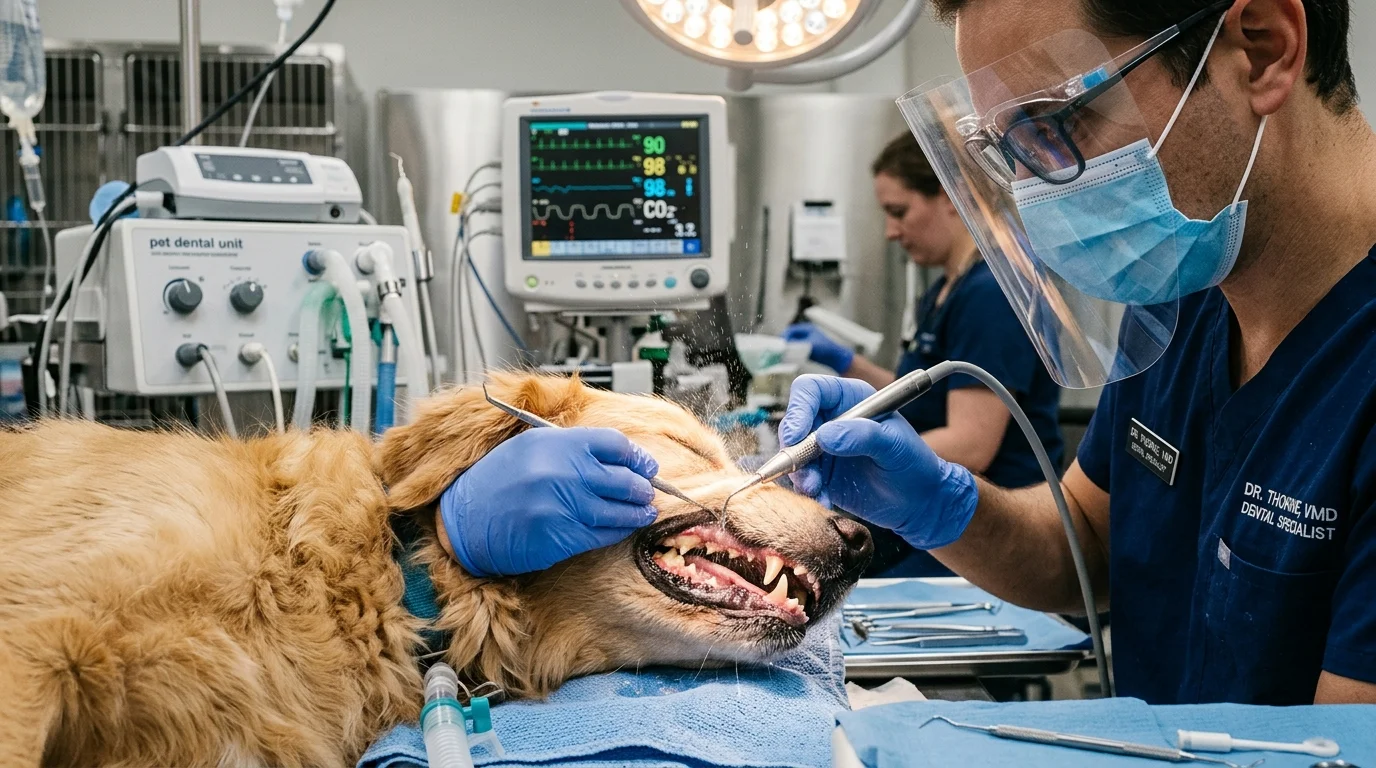
Many pet owners avoid essential professional dental cleanings due to fear of general anesthesia, especially in senior or geriatric dogs. However, “anesthesia-free” cosmetic teeth scraping performed at grooming salons is dangerous and medically ineffective: it merely scrapes the visible crown with sharp dental scalers while leaving the pathogenic subgingival bacterial biofilm completely untouched beneath the gums, giving owners a false sense of security while root resorption progresses.
Modern veterinary dentistry mitigates anesthetic risk through advanced clinical protocols: comprehensive pre-anesthetic blood chemistry profiles, continuous multi-parameter telemetry monitoring (ECG, capnography, pulse oximetry, blood pressure), proactive IV fluid therapy, and local dental nerve blocks that reduce required gas anesthesia depth by up to 50%. The proven life-extension benefits of eradicating systemic periodontal infection far outweigh the minimal risk of a controlled, modern veterinary anesthetic procedure.
The Role of Nutrition in Plaque Prevention: Kibble Myths
A widespread misconception among dog owners is that standard commercial dry kibble “cleans teeth” through chewing friction. In clinical reality, standard extruded kibble shatters instantly upon contact with canine carnassial teeth with zero subgingival cleaning action, leaving starchy carbohydrates that feed oral plaque bacteria. Specialized veterinary dental diets (such as Hill’s t/d or Royal Canin Dental) utilize a non-crumbling fiber matrix that physically scrapes the tooth surface to the gingival margin, providing legitimate mechanical cleaning.
Systemic Biomarker Reductions Following Dental Prophylaxis
The systemic health impact of professional periodontal therapy is directly measurable through objective veterinary laboratory biomarkers. In prospective clinical trials tracking canine patients before and after subgingival ultrasonic scaling and polishing, systemic inflammatory and cardiovascular markers drop precipitously within 21 days:
- C-Reactive Protein (CRP): Serum concentrations of this acute-phase hepatic inflammatory protein decline by an average of 42% following the eradication of oral bacterial colonies.
- Cardiac Troponin I (cTnI): Circulating markers of micro-myocardial injury decrease significantly, confirming that eliminating oral bacteremia directly halts micro-vascular cardiac damage.
- Symmetric Dimethylarginine (SDMA): Stabilization of early renal filtration markers occurs as kidneys are relieved of the chronic immune complex burden generated by continuous oral infections.
Clean canine teeth are not an aesthetic luxury; they are a fundamental longevity requirement. Establishing daily enzymatic toothbrushing or feeding raw recreational marrow bones prevents chronic bacteremia, protecting your dog’s heart valves and kidneys throughout their senior years.